
When Your Roof Has Reached End Of Life
Most pitched roofs in Leicestershire reach the end of their working life between 60 and 100 years from new, depending on the original materials and how well they've been maintained. The signs are usually unmistakable: tiles that crumble in your hand when you pick one up, slates that sound dead when you tap them, persistent damp patches that come back every winter no matter how many tiles you replace, daylight visible through the roof when you look up from inside the loft, and bitumen felt underlay that has gone brittle and crumbled away from the rafters.
By that stage, replacing individual tiles or patching the felt is throwing good money after bad. The next storm just lifts another row, the felt crumbles further, and you're back on the phone in four months. A proper full re-roof with new membrane, new battens, modern insulation and either re-laid original materials or new tiles will give you 50-100 more years of trouble-free roof, plus a much warmer house, plus the option to upgrade for solar later.
What's Included In A Full Re-Roof
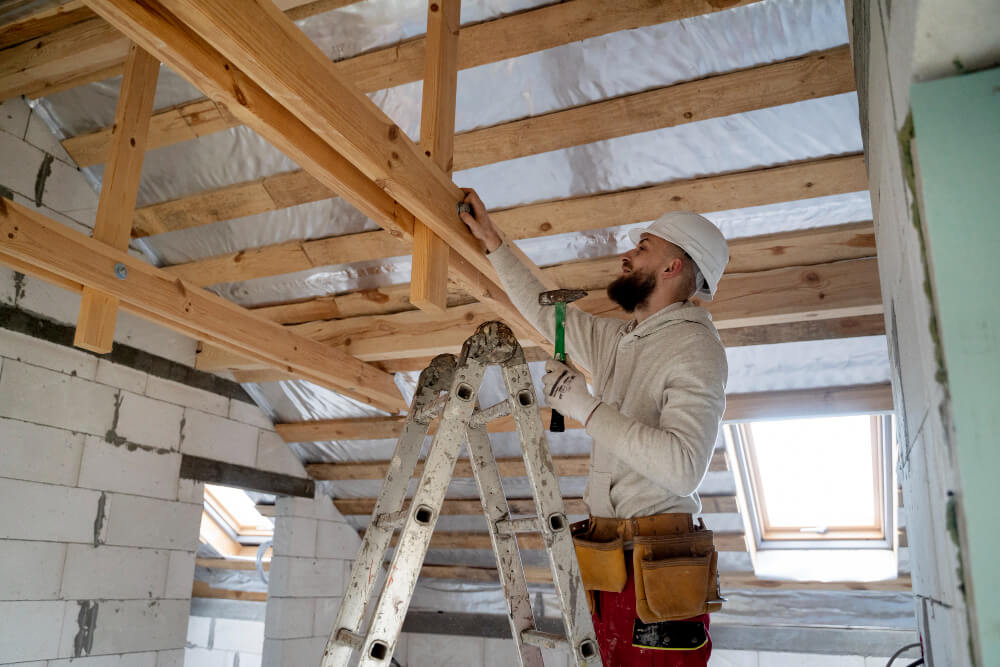
A proper full re-roof strips the existing tiles or slates, the battens, and the felt all the way back to the rafters. Any rotten or undersized rafters get scarfed or sistered. Modern Klober breathable membrane (or equivalent) goes on next, lapped and dressed to current details. New treated softwood battens are fixed at the right gauge for your tile or slate type. New insulation goes in — either at ceiling level (270mm mineral wool minimum) or at rafter level (150mm PIR) depending on whether you have a cold or warm roof.
Then the tiles or slates go on. Where the existing covering is sound (Welsh slate, good clay tiles), we'll often re-lay the originals onto the new membrane and battens with new lead nails or copper hooks. Where the originals are spent, we'll quote for fresh material in a matching profile. Lead flashings, hip irons, ridge tiles, valleys and abutments are all renewed as standard.

Building Regulations & Insulation
Every full re-roof in England triggers Building Regulations Approved Document L — the energy efficiency requirement. The minimum U-value for a replacement roof is currently 0.15 W/m²K, which in practice means 270mm of mineral wool insulation at ceiling level for a cold roof, or about 150mm of PIR insulation between and over the rafters for a warm roof. This is included in our quotes by default, not added on as an extra.
We notify Building Control on every job and arrange the inspection at the appropriate stages. The completion certificate goes to you with the rest of the handover paperwork — you'll need it for any future house sale or remortgage.
Loft Conversions & Velux Windows
If you're considering a loft conversion at any point in the next 5-10 years, the time to fit Velux windows and reinforce the rafters is during the re-roof — not afterwards. We can include Velux installation, additional rafter doubling for future floor loading, and warm-roof PIR insulation as part of the re-roof spec at much lower cost than retrofitting later. Worth thinking about even if a full conversion isn't on the cards now.

Frequently Asked Questions
How long does a full re-roof take?
A typical 3-bed semi takes 5-8 working days. A larger detached house is 10-15 days. Bungalows are quicker (3-5 days). Scaffold time on top of that is usually 1-2 days each end.
Can I stay in the house?
Yes — we plan re-roofs to be liveable. There's noise during 8am-5pm, scaffold at the windows, and dust in the loft, but the house remains secure and weatherproof every night.
What if it rains during the work?
We strip one elevation at a time and have breathable membrane down within hours. If heavy rain threatens we tarp the exposed area and pause.
Do I need planning permission?
Like-for-like replacement is permitted development. Conservation areas, listed buildings, and any change of pitch or shape need permission.
How much does a new roof cost?
A typical 3-bed semi in Leicester re-roofed in concrete tile, with full membrane and insulation upgrade, is usually £8,000-£14,000 inclusive of scaffolding. Welsh slate re-roof is significantly higher (£15,000-£25,000 typically).